You Shouldn’t Have Been Awake
Written by Rebecca Lee
Edited by Renee Lee
Surgery preparation seemed to flow according to plan. During the day of your scheduled surgery or procedure, you are finally taken to the operating room, placed under anesthesia, and the surgical team proceeds with your operation. Ideally, you should have been “asleep” for the full duration of the operation, ensuring that you do not remember any pain associated with the procedure after waking up. However, instead of the surgery maybe feeling like a nap, it felt excruciating and paralyzing. Something has gone very wrong.
My understanding of this phenomenon could have been shaped by different sources in the past, including my favorite show Grey’s Anatomy. Although one could debate its medical accuracy, this circumstance could describe a very real and traumatizing experience for patients. Anesthesia Awareness is a rare event in which a patient gains consciousness during their surgery with general anesthesia [1]. For context, this phenomenon could occur “in one or two out of every 1,000 cases” [1]. The Cleveland Clinic describes how this experience is not the same as “‘waking’ in the typical sense”, but rather a series of shorter bursts of consciousness that could bring forth different effects or experiences for patients [1]. Anesthesia awareness events may include hearing sounds/conversations occurring, being “in a dreamlike state”, waking up and not being able to move, and experiencing pressure (or even rarely, pain) [1]. A notable characteristic about anesthesia awareness is that this event occurs when using general anesthesia as a sedation method, since general anesthesia overcomes the patient’s automatic bodily functions, such as breathing [1]. This is in contrast to other sedation approaches such as IV sedation, as these still allow patients to breathe by themselves [1].

Illustration by Yuko Shimizu via Boston University. Curated by Hailey Foster (hf348@cornell.edu).
In regards to probability, it is difficult to determine the precise chances of experiencing anesthesia awareness [1]. However, “on average,” this happens in around “1 to 2 out of every 1,000 cases” [1]. Possible causes include a lack of anesthetic drug administration, differences in needs for anesthesia among patients (including those with significant anxiety), and machine-related or equipment check-related errors [1]. An article in frontiers also discusses risk factors of “Intraoperative Awareness (IOA)”, including surgery type [2]. More specifically, IOA rates were higher for obstetric, thoracic, and cardiac surgery [2]. Additionally, “acquired resistance to anesthetic drugs” were mentioned with the reference to the “chronic use of alcohol, opioids and sedative-hypnotics” [2]. One idea that was shocking to me is the fact that almost “73.6% (81/110) of the definite/probable IOA case reports examined by NAP5 were deemed avoidable” [2]. Due to this, assessing the risk factors as well as taking the necessary steps for prevention are the main pathways for evading IOA [2].
The American Society of Anesthesiologists provides some degree of reassurance about anesthesia awareness by describing how even if “it can be upsetting, patients usually do not feel pain” [3]. However, it was also acknowledged that based on the event as well as the person, anesthesia awareness could be traumatic [3]. Some advice to lower the risk for this event include discussing with the anesthesiologists regarding any prior issues involving anesthesia, any history, all supplements as well as medications being taken, any worries or concerns, and any history of alcohol as well as drug usage [3]. Based on this information, it is a relief, at least to some degree, that there are several steps to hopefully reduce the chances of anesthesia awareness taking place. However, this makes me curious about the possible effects of potentially forgetting to mention a certain supplement, medication, or any other relevant detail. To my understanding, there are various medical charting services to ensure that such information is recorded, but what if different hospitals utilize different charting platforms that ultimately contain varying pieces of information, but do not always transfer over to one another?
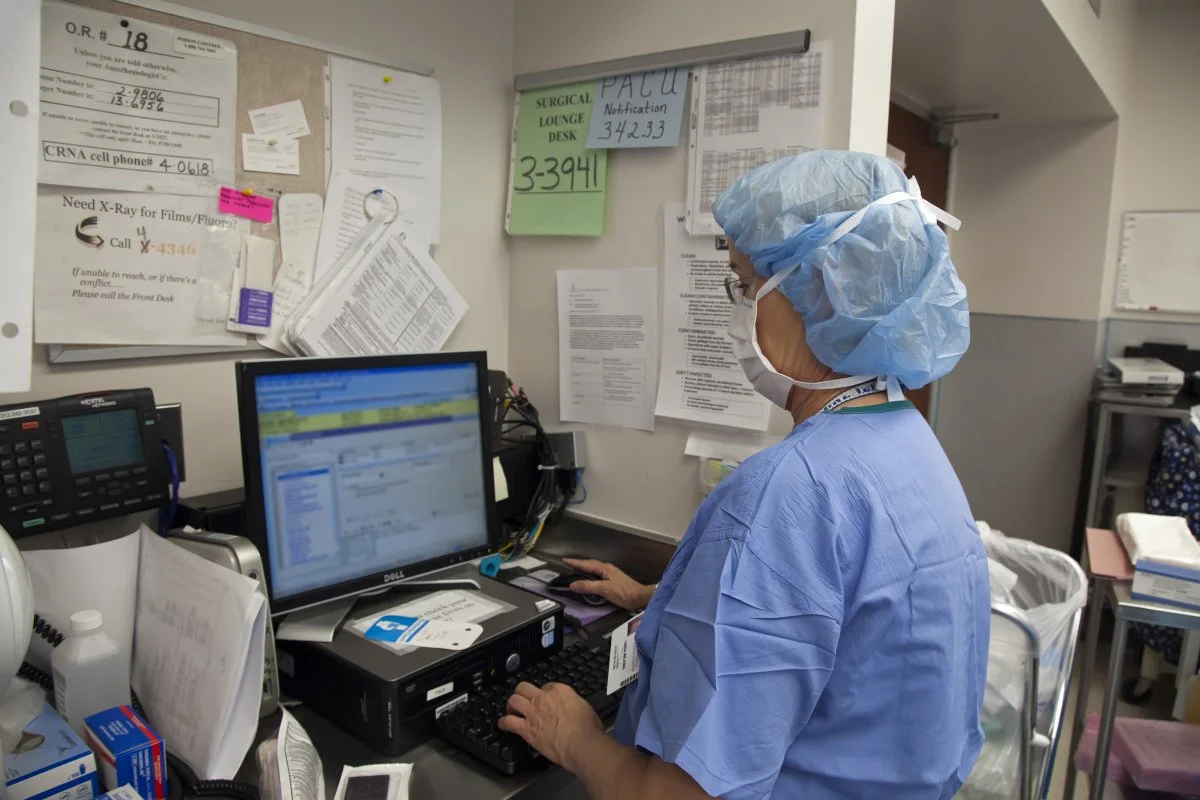
Photo taken by Jim West via LaborNotes. Curated by Hailey Foster (hf348@cornell.edu).
Based on the information presented, it is evident that anesthesia awareness isn’t a simple phenomenon. Additionally, it is clear that there could be various risk factors to consider. Based on these sources, we also know that exact probabilities of experiencing this event are difficult to determine, but there are action steps that could be taken toward decreasing the risk. Furthermore, I believe the advice to discuss any worries or concerns with the anesthesiologist emphasizes the support that patients should have. From these sources, we can understand how anesthesia awareness, although usually painless, still holds the possibility of being a traumatic event. Therefore, it is valuable to continue exploring the intricacies of this phenomenon.
Rebecca Lee ‘28 is studying Human Biology, Health, and Society in the College of Human Ecology. She can be reached at rl898@cornell.edu.