Eating the Inedible: Ideonella sakaiensis
Written by Terrance Miao
Edited by Brianna Beckham
A streak of sweat runs down the sides of your neck. Has it ever been this hot? You may think you’re the only one pondering whether it has ever been this hot before. Yet you’re not alone. Earth’s temperature has increased 2 °F since 1860 and it is only getting warmer (NOAA, 2025). In fact, the 10 warmest years in the past 175 years have all happened between 2015-2024. This can be explained by climate change: long-term shifts in temperature and weather patterns. When greenhouse gases are released into the atmosphere, they trap the sun’s heat, increasing the global temperature. Human activities are to blame: cutting down trees, high consumption of fossil fuels, and the mass production of plastics. Even though the harm is done to our environment, we can mitigate the impact of these activities. But how? Meet Ideonella sakaiensis.
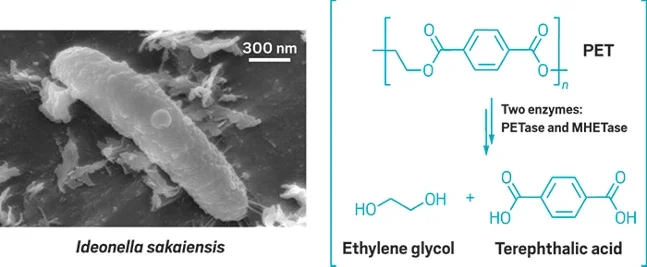
Photo from ACS C&EN. Curated by Hailey Foster (hf348@cornell.edu).
These microorganisms shorten the decomposition time of PET plastics. These plastics can take up to 1,000 years to decompose in landfills, leaching toxic chemicals. PET plastics are a strong and lightweight plastic that is used for food and drinks, such as water bottles and food trays. They are known to be extremely durable and would eventually break down into smaller microplastics. Discovered in 2016, Ideonella sakaiensis breaks down these PET plastics into their monomers terephthalic acid (TPA) and ethylene glycol (EG), which is used for energy and growth. Without plastic, Ideonella sakaiensis do not get the sustenance it needs and die.
The enzyme PETase turns PET plastic into the intermediate MHET. The enzyme MHETase breaks MHET into TPA and EG. Ideonella sakaiensis breaks down a thin PET film in about 6 weeks – quite a stark contrast to its absence.
Researchers are currently isolating PETase and MHETase from Ideonella sakaiensis and modifying the genes to make them operate faster and more stable. Engineered enzymes can degrade a thin PET film in hours. However, it should be noted that there are differences depending on the type of surface. For example, water bottles are harder to degrade compared to food trays.
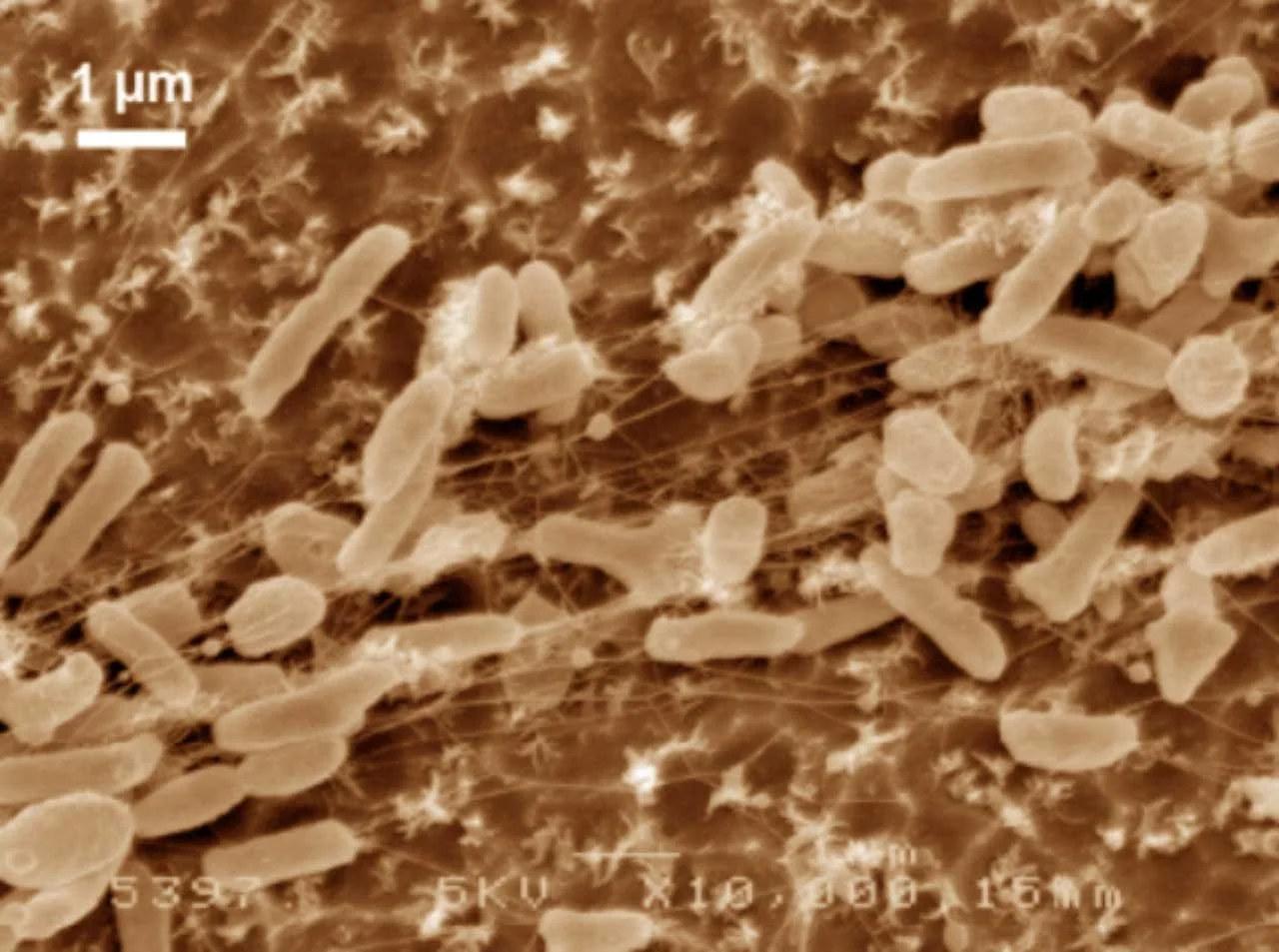
Photo from Sci News. Curated by Hailey Foster (hf348@cornell.edu).
Another way scientists are trying to involve these microorganisms is by transferring the genes for the enzymes into faster microorganisms such as yeast to mass produce the enzymes. While the research into Ideonella sakaiensis is still in its early stages, the bioengineering of its enzymes marks a milestone in utilizing microbiology to reduce the long-term impact of climate change.
Terrance Miao ’27 is in CALS. He can be reached at tm672@cornell.edu.