Written by Sophia Gerrans
Edited by Rathusha Nimalan
In August, Florida Republican congressional candidate Ben Butler released a political advertisement titled “Honesty in Washington.” It features Butler visiting a field of donkeys, claiming, “After meeting these guys, I owe them an apology. They are a lot more honest than the jacka***s in Washington.”
Butler’s attempt at a biting remark falls flat for one reason: democrats have been claiming the jackass since 1828. During his presidential campaign, Andrew Jackson was referred to as “A. Jack-ass” to mock his populist political views and famously stubborn personality. Much to his opponents’ dismay, Jackson incorporated the donkey into his campaign posters, reframing his stubbornness as charming rather than a flaw.
It was not until after Jackson’s presidency that the donkey became the symbol of the entire Democratic Party. Political cartoonist Thomas Nast used the donkey iconography in an 1870s issue of Harper’s Weekly – representing an anti-war party Nast disliked. His crowning piece was published in the 1874 issue of Harper’s Weekly titled “Third Term Panic.” It depicted the current political debate around Ulysses S. Grant’s consideration of a third term –a time before the 22nd Amendment, which capped the presidency at two terms. In the piece, Nast presents a donkey wearing a lion skin branded with the word “Caesarism” roaring at the animals in the forest – a critique of what he saw as Democrats’ fear-mongering efforts to portray a potential third Grant term as a step toward dictatorship. Among the frightened critters, an elephant brandishing the words “Republican’s vote.” Nast disliked the Democratic Party and disagreed with its campaign against a third Grant term, but he simultaneously gave Democrats a gift by cementing the donkey in one pen stroke.
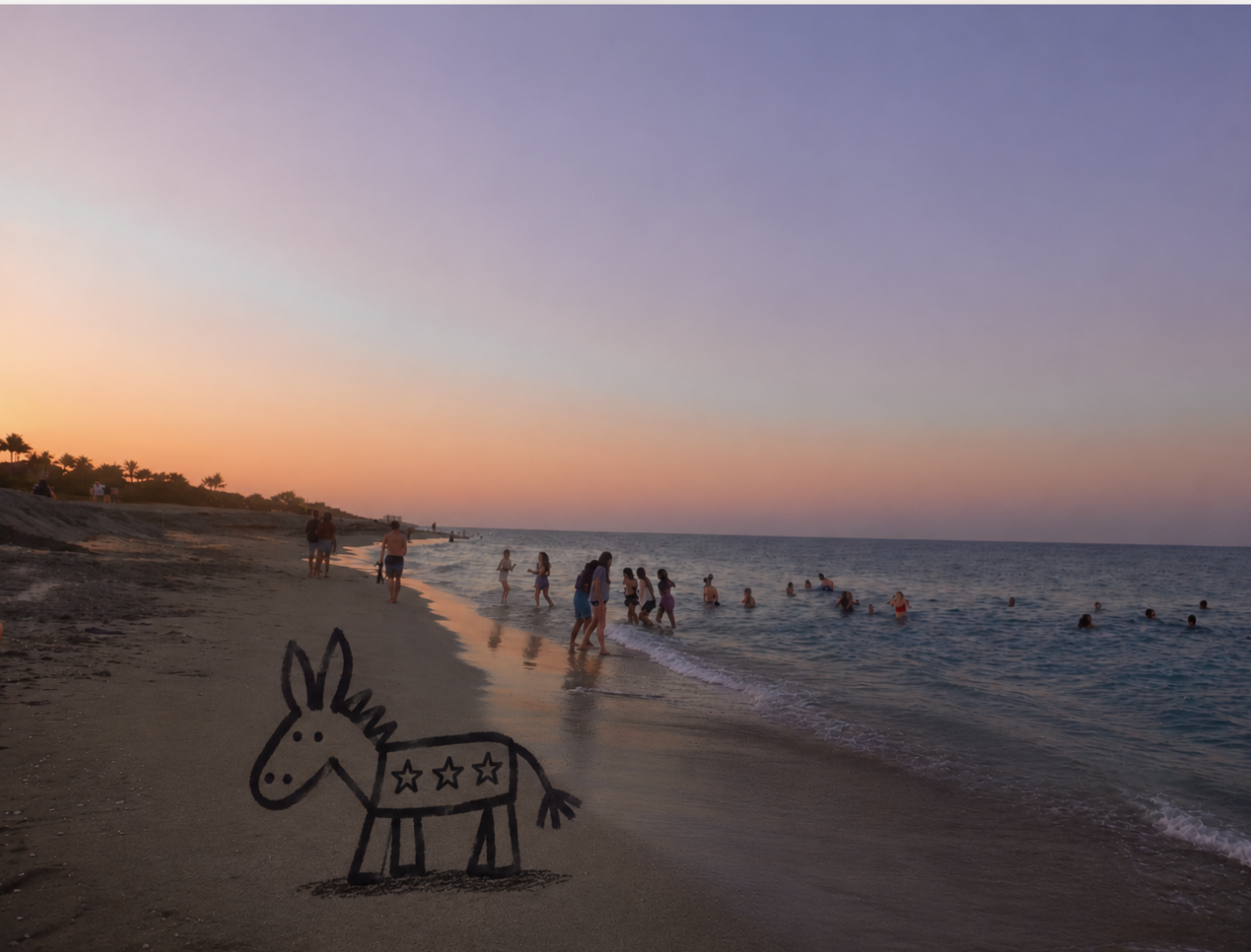
Photo illustration courtesy of Gayatri Sathyanarayan (gs778@cornell.edu)
The Democrats’ donkey was born at a time when political party loyalty ran high, and the emblem continues to be ingrained in American politics today. But the symbols have not remained unchanged. As Smithsonian American History Museum curator Lisa Grady explains, political party symbols have become less fierce. She points out, “They [now] have soft, rounded edges. They don't wreak havoc as much; they can kick… but they are not violent animals anymore.” Yet even as the shape softens, their associations remain just as cutting.
In 2024, researchers from the University of Texas at Austin investigated how political symbols influence polarization. In an experiment involving over 1,000 participants, researchers found that simply seeing the opposing party’s symbol increased feelings of anger and anxiety while decreasing enthusiasm, compared to seeing national symbols. These emotions were associated with more negative perceptions of the opposing party’s supporters. In other words, something as simple as a cartoon donkey can become a stand-in for an entire political party, allowing people to direct their frustrations toward a single, recognizable image.
Nearly two hundred years after Jackson first embraced the jackass, history continues to repeat itself, moving from nineteenth-century political cartoons to modern campaign ads. Through it all, the donkey remains just as politically charged: a symbol of both party unity and partisan division.
(Sophia Gerrans ’27 is in the College of Agriculture and Life Sciences. She can be reached at sg2388@cornell.edu.)