Why a 1971 Alaska Land Deal Still Matters: The ANCSA Question
Written by Hannah Katchen
Edited by Claudia Reines
In 1985, at age 69, Katie John filed a federal lawsuit for the right to fish at Batzulnetas, where her ancestors had fished for thousands of years. The State of Alaska had closed the fishery in the 1960s, but in 1971, the Alaska Native Claims Settlement Act did something unprecedented in federal Indian law: it extinguished all aboriginal hunting and fishing rights in Alaska. Katie John spent the next 28 years in court, winning three separate rounds of federal litigation, just to secure a subsistence priority on about 60% of Alaska's waters—a fraction of what her people had lost. She died on May 31, 2013 at age 97, less than two months before the final legal victory that bears her name. Her story encapsulates the central paradox of ANCSA: Alaska Natives received the largest land-claims settlement in American history—44 million acres and nearly $1 billion—yet spent the next five decades litigating to restore rights extinguished by the settlement.

Photo of Katie John from KTOO. Curated by Camille Parisot (cap364@cornell.edu).
ANCSA was a characteristically American compromise: it solved immediate political problems but created new issues that still cause tensions today. In 1971, pressure for a settlement was overwhelming. Oil had been discovered at Prudhoe Bay, but the pipeline couldn't be built across contested lands. Alaska Natives had blocked the state from claiming the 103 million acres it was owed under the Statehood Act. Native villages also faced catastrophic poverty— the life expectancy here was 34 years, 95% of children had tuberculosis by age 14, and unemployment was 60%. The solution was radical: instead of creating reservations, Congress established a corporate model, distributing land through 13 regional and over 200 village corporations owned by Native shareholders. Whether this was successful depends on the viewpoint.
For economic development, resource-rich regions thrived, special contracting advantages created opportunities, and life expectancy improved in places like the North Slope. For cultural preservation, the corporate model conflicted with traditional values, blood quantum requirements meant Native shareholders would eventually disappear, and the subsistence economy would continue to decline. Regarding political sovereignty, ANCSA did not clarify the extent of governmental authority over villages, which sparked 50 years of litigation, and Alaska did not recognize tribal sovereignty until 2017. This essay examines ANCSA through three questions: First, what historical context made the settlement act seem necessary? Second, what did it actually deliver versus what was promised? And third, were there better alternatives?
In 1971, Congress passed the Alaska Native Claims Settlement Act, the largest land deal in American history, and it was drastically different from any previous treaty with Native Americans. Rather than establishing reservations and tribal governments, ANCSA created corporations with shareholders. Alaska Natives received 44 million acres and nearly $1 billion, but surrendered all aboriginal hunting and fishing rights in exchange. The corporate model did not emerge from nowhere. Alaska had always occupied a unique legal position: when Russia controlled the territory, Indigenous peoples were treated as individual subjects rather than as separate nations. Russian men married Native women, the Orthodox Church baptized Natives regardless of race, and when the U.S. purchased Alaska in 1867, it inherited this framework–no treaties, no reservations, and courts ruled Alaska wasn't "Indian country."By the 1960s, the consequences were catastrophic: life expectancy was devastatingly low, 95% of children had tuberculosis, and unemployment reached 60%. Then oil was discovered at Prudhoe Bay in 1968, igniting litigation overland disputes. The trans-Alaska pipeline couldn't be built across land with unresolved ownership, the new state could not claim its 103 million acres because Natives had filed protests, and villages were blocking development while their people were dying. The result was a pragmatic compromise: ANCSA unfroze the land, enabled the pipeline, and provided compensation. However, this created structural problems that would take decades to fully surface.

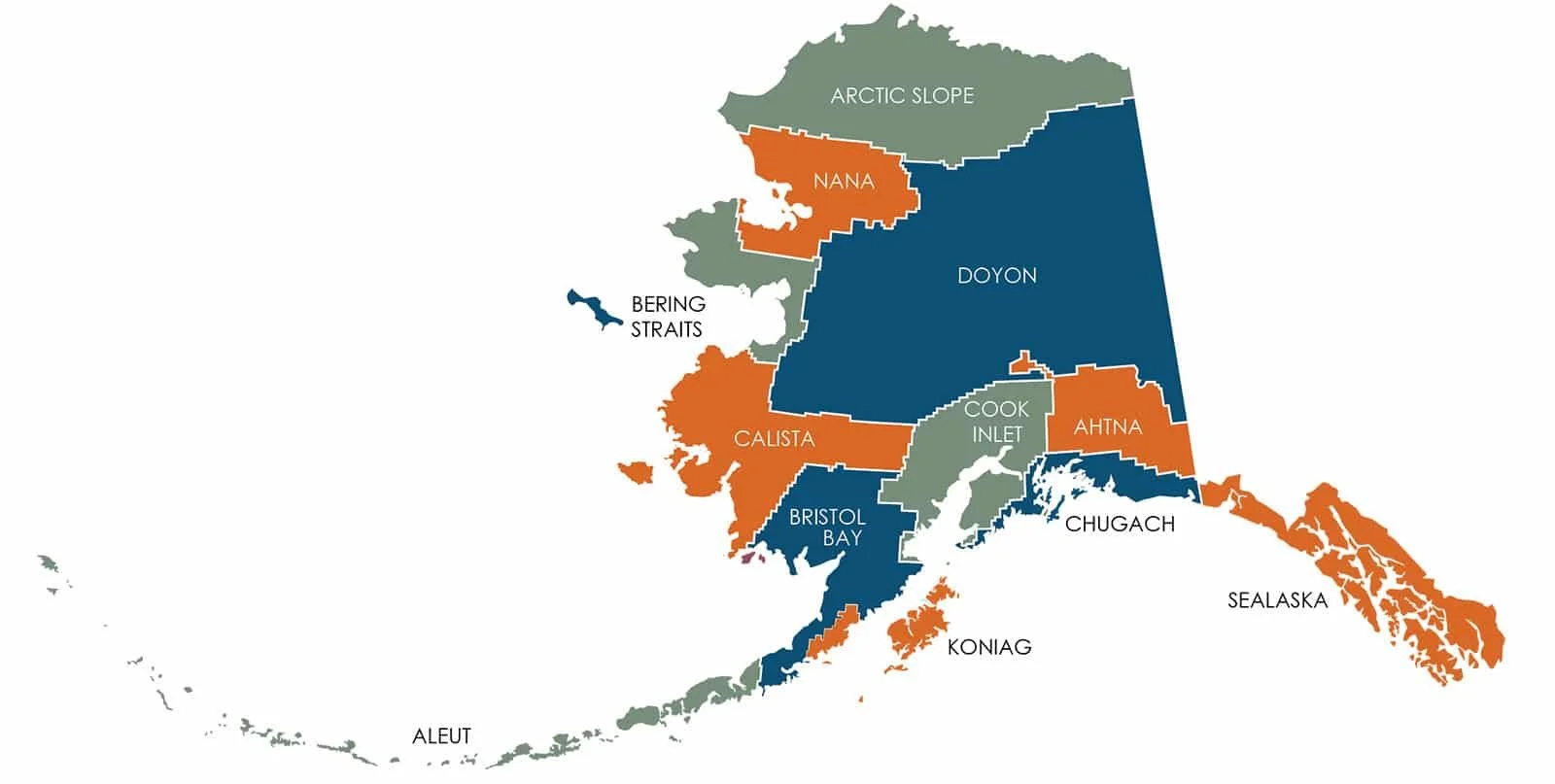
Photo of Alaska Native Corporation Headquarters (left) and ANCSA Regional Association (right). Curated by Camille Parisot (cap364@cornell.edu).
What ANCSA promised and what it delivered were two different things. Native leader Emil Notti testified to Congress about his vision: "I visualize sawmills coming into being to start a housing program. I visualize native businesses beginning to alleviate unemployment." He declared boldly, "We do not want paternal guidance from Washington, D.C. We feel we have the ability to make our own way." Fifty years later, the outcomes did not fully live up to his vision. Alaska regions sitting on oil, timber, or minerals thrived, North Slope communities saw dramatic gains in life expectancy as oil revenues flowed in, and Native corporations leveraged the federal 8(a) program to win hundreds of millions in government contracts. But villages without natural resources still struggle with severe poverty, and revenue-sharing provisions haven't closed the gap. Beyond economics, ANCSA left Alaska Natives without the political tools to govern themselves. Unlike tribes in the Lower 48 that hold treaty rights to resources, Alaska Native villages remained tangled in federal and state oversight. Alaska did not formally recognize tribal sovereignty until 2017, forty-six years after ANCSA was enacted. The extinguishment of subsistence rights hit hardest in rural communities where hunting and fishing are foundational. The blood quantum requirement that states one-quarter Native ancestry to qualify as a shareholder built demographic decline directly into the law's architecture. As Native descendants intermarry across generations, fewer and fewer will qualify, a dynamic one tribal official described plainly as the corporations eventually running out of eligible members. ANCSA delivered economic opportunity for some, but not cultural continuity or political self-determination for most.


Photo from Alaska Public Media (left) and Wikipedia (right). Curated by Camille Parisot (cap364@cornell.edu).
Looking back, the question isn't just whether ANCSA was flawed but whether anything better was realistically achievable. The Deputy Director of Tribal Government and Client Services at Tanana Chiefs Conference, who works inside these structures daily, offers a candid answer: "the federal government was primarily motivated by getting drilling access—that drove everything. There might have been alternatives, but the political will simply wasn't there for a better deal. ANCSA was probably the best deal available at the moment, even if flawed." Native villages had leverage through land protests, but they couldn't hold out indefinitely against oil companies, a cash-hungry new state, and a federal government that wanted the pipeline built. Even the reservation alternative carried serious risks. Senator Scoop Jackson had seen the crushing poverty on Lower 48 reservations and the Bureau of Indian Affairs' long history of forced relocations and boarding school trauma. The problem is that what ANCSA provided came with its own pitfalls. Federal funding for heating assistance, nutrition programs, and basic services sustains villages, especially as fish stocks decline, but accepting such funding entails federal control over land decisions. It's what the Deputy Director calls a "sticky wicket": the path toward true sovereignty runs directly through the loss of the resources needed to survive. The original legislation would have allowed stock to be sold to non-Natives after 1991, which would have wiped out the Native land base entirely. Congress had to intervene with the 1991 amendments just to prevent that outcome. ANCSA has been amended repeatedly because it was rushed, and the issues it left unresolved, such as subsistence rights, tribal jurisdiction, and blood quantum, still require congressional action to fix. Whether the trade-off was worth it ultimately depends on whether one believes a better deal was ever on the table.
The consequences of ANCSA still persist today. Moreover, the same tensions that shaped the 1971 compromise still currently define life in Alaska Native communities: villages caught between federal dependency and self-determination, subsistence practices in legal limbo, and corporations slowly running out of eligible shareholders as blood quantum requirements erode the very population they were meant to serve. Katie John spent 28 years in court just to reclaim a fraction of what ANCSA took in an instant, and the rights she fought for remain fragile. For the rest of America, ANCSA offers a window into how federal Indian policy actually works, not through grand gestures of justice, but through political compromise shaped by economic interests, where the needs of Native people are weighed against oil pipelines and state budgets. Studying ANCSA forces a harder question than simply whether it was a good deal: it asks one to reckon with what the United States has consistently been willing and unwilling to give up in order make gains on Native land.
Hannah Katchen ‘28 is in the College of Arts and Sciences. She can be reached at hbk42@cornell.edu.
Sources:
[1] Anderson, Robert T. "The Katie John Litigation: A Continuing Search for Alaska Native Fishing Rights After ANCSA." Arizona State Law Journal, vol. 51, no. 845, 2019, pp. 845-877.
[2] "Sovereignty and Subsistence: Native Self-Government and Rights To Hunt Fish and Gather After ANCSA." Alaska Law Review, vol. 33, 2016, pp. 187-219.
[3] Alaska Native Land Claims: Hearings before the Committee on Interior and Insular Affairs, United States Senate, Ninetieth Congress, Second Session on S. 2906. U.S. Government Printing Office, 1968.
[4] Alaska Native Claims Settlement Act, Pub. L. No. 92-203, 85 Stat. 688 (1971) (codified as amended at 43 U.S.C. §§ 1601-1629h).
[5] Alaska National Interest Lands Conservation Act, Pub. L. No. 96-487, 94 Stat. 2371 (1980) (codified as amended at 16 U.S.C. §§ 3101-3233).
[6] Cherokee Nation v. Georgia, 30 U.S. (5 Pet.) 1 (1831).
[7] Dr. Liz Ross [Deputy Director, Tanana Chiefs Conference]. Personal interview. .
[8] Elk v. Wilkins, 112 U.S. 94 (1884).
[9] Judy Rabinowitz [Former DOJ Attorney, Indian Resources Section]. Personal interview. 2/15/26.
[10] John v. United States (Katie John I), 72 F.3d 698 (9th Cir. 1995).
[11] John v. United States (Katie John II), 247 F.3d 1032 (9th Cir. 2001) (en banc).
[12] John v. United States (Katie John III), 720 F.3d 1214 (9th Cir. 2013).
[13] Knapp, Lyman E. "A Study upon the Legal and Political Status of the Natives of Alaska." The American Law Register, vol. 39, no. 5, May 1891, pp. 325-339.
[14] McDowell v. State, 785 P.2d 1 (Alaska 1989).
[15] Notti, Emil. "Statement of Emil Notti, President, Alaska Federation of Natives." Alaska Native Land Claims: Hearings before the Committee on Interior and Insular Affairs, U.S. Senate, 90th Cong., 2nd sess., 8-10 Feb. 1968, pp. 31-34.
[16] Parran, Thomas, et al. Alaska's Health: A Survey Report to the United States Department of the Interior. University of Pittsburgh Graduate School of Public Health, 1954.
[17] Sturgeon v. Frost (Sturgeon I), 136 S. Ct. 1061 (2016).
[18] Sturgeon v. Frost (Sturgeon II), 139 S. Ct. 1066 (2019).
[19]Treaty Concerning the Cession of Russian Possessions in North America by His Majesty the Emperor of All the Russias to the United States of America, U.S.-Russ., 15 Stat. 539 (ratified May 28, 1867).
[20] United States v. Alaska, 422 U.S. 184 (1975).
[21] Worcester v. Georgia, 31 U.S. (6 Pet.) 515 (1832).