The Art of Understanding Dementia
Written by Justin Choi
Edited by Gesi Huang
A man lounges on a sofa in a room he finds unfamiliar when his phone rings. Though the caller claims to be his daughter, he does not recognize her voice, nor can he find the words to ask where he is. Sensing his confusion, she tells him that he is in his childhood home. The man has moderately severe dementia. Yet, it would be a critical mistake to deem the man stripped of his personhood — or ‘gone.’
Dementia researchers understand why this assumption is erroneous. Alzheimer’s disease, the most common form of dementia, begins as neurodegeneration in the hippocampus and the medial temporal lobes. Since these regions of the brain are responsible for episodic memory, verbal expression, and word recall, individuals with Alzheimer’s disease cannot reliably recall past events or communicate through language. To accommodate this, Alzheimer’s researchers avoid collecting data from patients via traditional verbal reporting methods such as interviewing, questionnaires, and symptom descriptions. They understand that their patients’ inability to respond well to verbal questioning is not because they lack experiences or individuality, but because the ability to express them is impaired.

Photo from Care Homecare. Curated by Hailey Foster (hf348@cornell.edu).
When verbal communication fails, art serves as an invaluable tool in dementia research, not only as a form of qualitative data collection but also as an effective means of scientific communication. Artistic processing relies on brain networks that decline only in the later stages of dementia, such as the networks in the parietal and occipital lobes, which support visual perception and spatial processing, and in the limbic system, which supports emotional processing and regulation. Even if an individual with dementia may not be able to express themselves through conversation, they can still communicate their emotions, learned skills, and their sense of self through art. Art thus serves as an alternative mode of communication that drives researchers towards a greater understanding of what it is like to experience dementia.
A study titled Dementia and Imagination (Jones et al.), published in 2016, provides a clear illustration of this. In the study, 125 people with mild to severe dementia took part in a 12-week visual arts program, and the researchers performed qualitative analysis not only of their artwork but also of their behavior during the session. Contrary to the misconception that people with dementia lack creativity or self-identity, the participants expressed their personal identity in their art through storytelling and aesthetic choices; they retained their artistic and creative abilities, despite cognitive impairment. Whereas verbal reporting would have revealed decline, this arts-based approach highlighted the remaining cognitive abilities of participants that otherwise would have been missed, challenging the harmful notion that people with dementia are defined by their inabilities, rather than their preserved strengths and personhood.
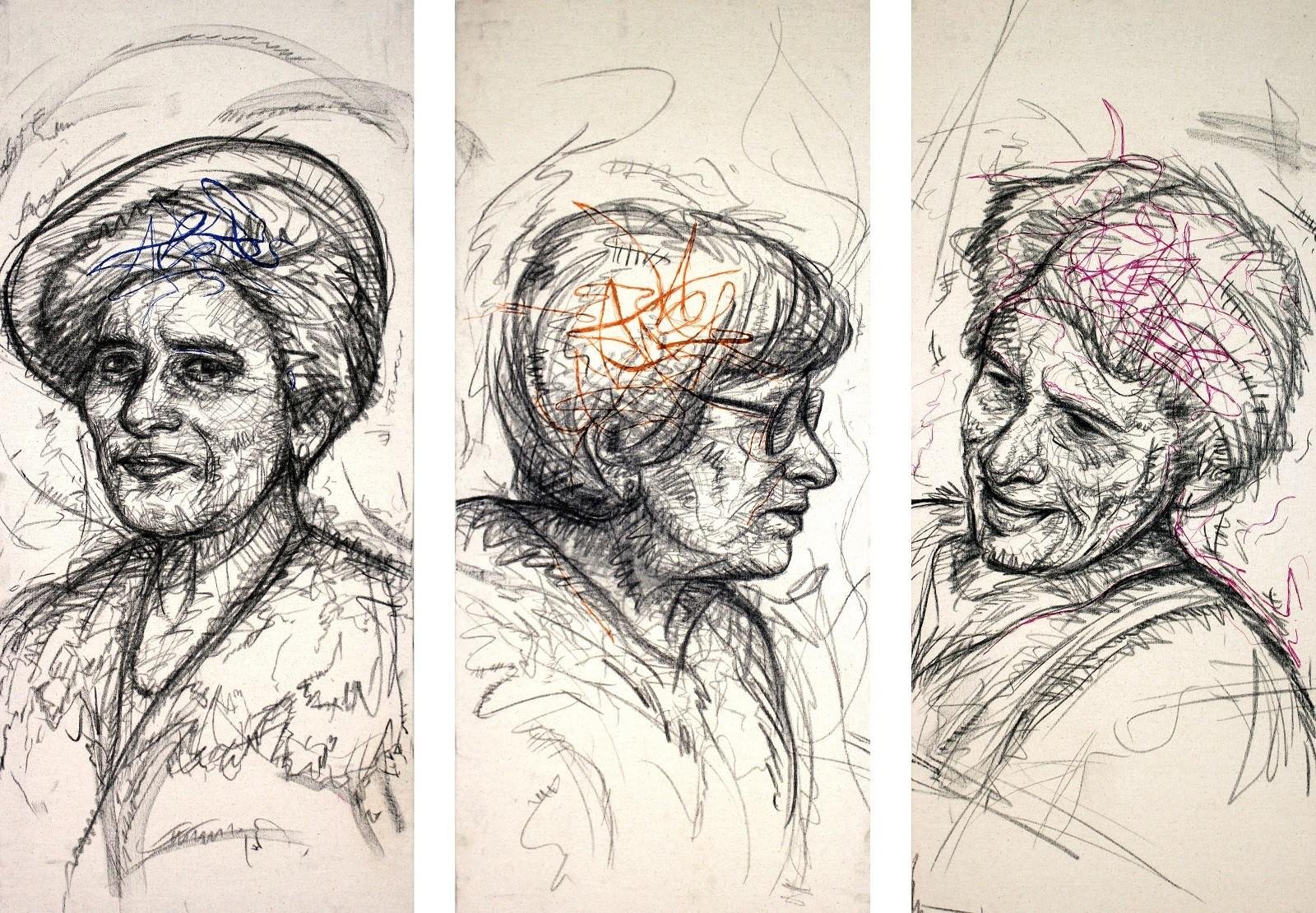
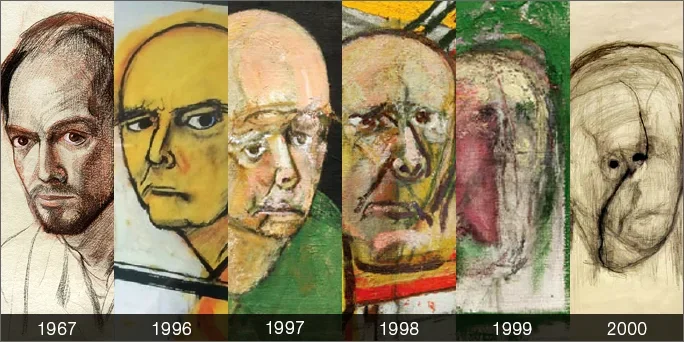
Artwork by Aneae via Alzheimer’s Society (left) and by William Utermohlen . Curated by Hailey Foster (hf348@cornell.edu).
For caregivers, it is especially important to recognize the capabilities of those in their care, as failure to do so may lead to the false impression that the person with dementia is ‘gone’ or ‘not really there anymore.’ This dehumanizing view can inadvertently make the person feel more like a task than a human being, causing neglect and reduced quality of care.
In addition to serving as an alternative form of data collection on the psychology of a person living with dementia, art can be used by dementia researchers as a tool for scientific communication. For example, you might read a scientific paper detailing the molecular mechanism of Alzheimer’s disease and discussing what dementia does to a person in technical and objective terms — yet this paper would arguably fall short in conveying the full lived experience of dementia and how it feels from the inside. To access this human dimension, the consideration of artistic works can be more effective. For instance, the album Everywhere at the End of Time by The Caretaker sonically simulates the progression of dementia by gradually distorting familiar melodies to reflect the fragmentation of memory. Similarly, the self-portraits of William Utermohlen visually trace the gradual erosion of identity as his dementia advanced. These works not only immediately foster empathy but also reveal dementia in a more intimate way that scientific jargon and graphs alone cannot, reminding us that dementia is not merely a disease to be studied but also a human experience to be understood.
Justin Choi can be reached at jjc436@cornell.edu.