Written by Anthony Tannous
Edited by Julia Xu
What do renowned A-list actress Anne Hathaway and the molecule perfluorooctanoic acid (PFOA) have in common? Well, they both conjure up a haunting reminder of the DuPont manufacturing scandal that took place throughout the early 2000s! The controversy has been sensationalized in Hollywood glamour since its events were depicted in the 2019 film Dark Waters, but the events are nonetheless harrowing. In the dramatic reenactment, Anne Hathaway and Mark Ruffalo played the legal power couple who pursued charges against DuPont for over a decade for polluting local waterways with the “forever chemical” PFOA. The story is mired in a long history of DuPont’s corporate neglect, contextualized by the movement for environmentally conscious chemical synthesis, and related to our modern struggle with AI data centers and water availability.
In 1984, Washington Works, the DuPont-owned facility responsible for this environmental oversight, conducted tests on Ohio River water sources that found PFOA had leaked out of the plant. Historically, the chemical had been used as a surfactant to aid in the manufacturing of Teflon frying pans, and both PFOA and Teflon were relied on for their long shelf-life and durability, earning them the nickname “forever chemicals.” Chemist Roy J. Plunkett at a New Jersey-based DuPont facility had encountered this class of compound in 1938 during an experiment to pressurize a canister of the monomeric tetrafluoroethylene gas (TFE). The result was the synthesis of Teflon, a seemingly indestructible solid polymer that resisted most acids and heat sources, and the chemists responsible for this breakthrough attributed these properties to the rigid chain of carbon-fluorine bonds holding the molecule together. PFOA was then also discovered nearly a decade later to aid in the Teflon coating process, and by 1961, these pans were launched into the American market as highly durable, non-stick appliances whose novelty was attributed to the use of Teflon. It comes as no surprise, then, that the chemicals that leaked into the Ohio River would pollute local water sources for decades. The report finding PFOA in the river was made in 1984, yet the residents of Little Hocking, West Virginia, were not notified for decades.

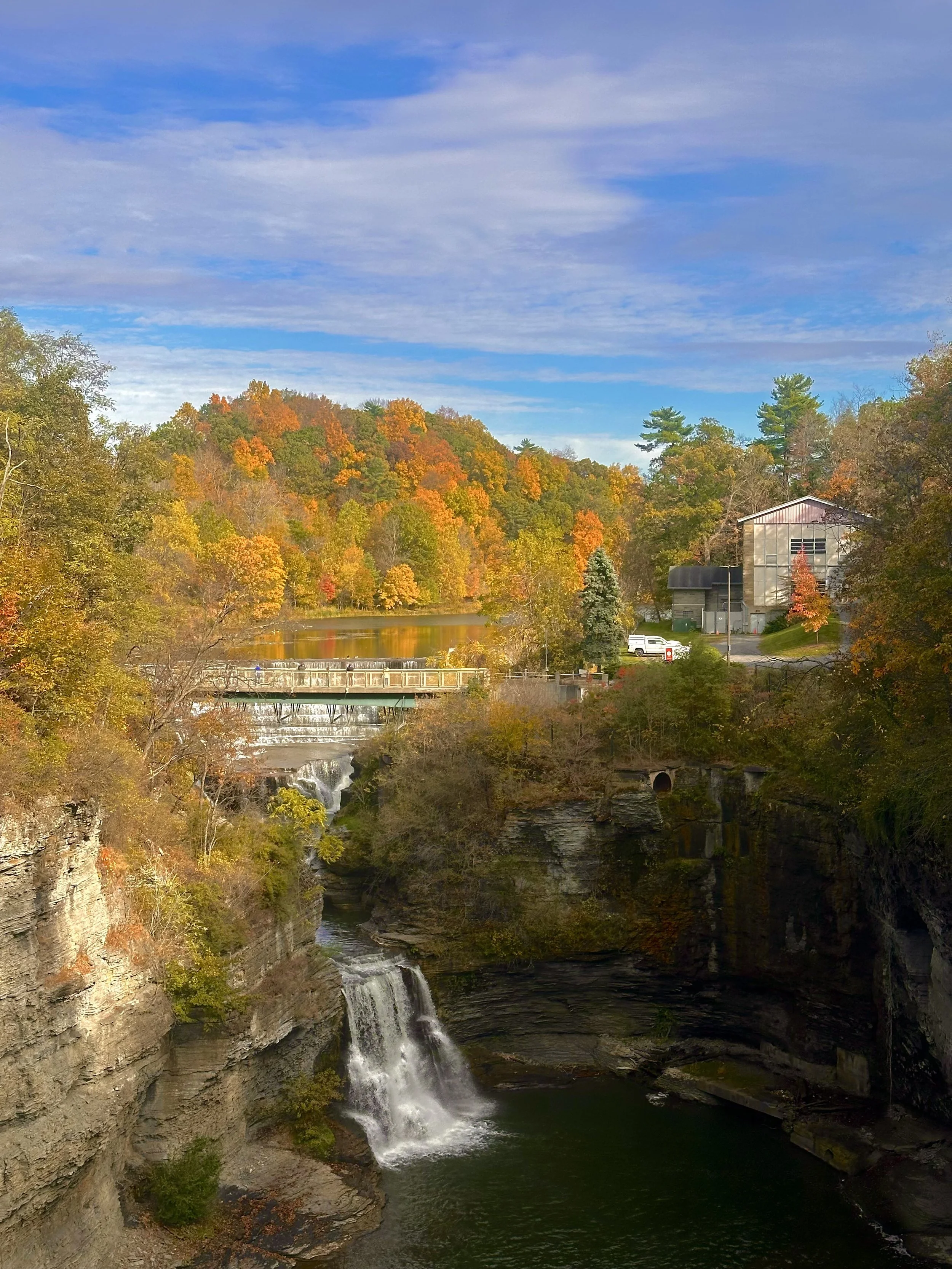


Photos by Gayatri Sathyanarayan (gs778@cornell.edu).
After vicious legal recourse and mobilization on both the local and federal scale, DuPont was finally held accountable for contaminating water sources along the Ohio River, resulting in an initial private settlement disbursed among the residents of Little Hocking in 2015. Yet, the long-term exposure to carcinogens could not be undone, and the victims were severely exposed to various forms of cancer. Once the lawsuit was settled, PFOA was barred from use in DuPont’s Teflon-coating process, and as of 2026, most industrial plants have enacted ostensible environmental awareness programs in an effort to minimize public outcry against the disposal of waste into freshwater sources.
Although much has been done to hold corporations accountable for environmental recklessness, these abhorrent practices do not cease with the crackdown on industrial manufacturers. Freshwater pollution has manifested with the advent of new industries, particularly with data centers for artificial intelligence. While media coverage has succeeded in garnering public awareness about the disastrous consequences of these plants for water availability, the onus does not just fall on the data centers themselves. AI processors require millions of gallons daily to cool down, but the computer chip manufacturers and power plants supplying these data centers assert additional demands on water availability for their own operations. AI development has rapidly gained momentum, even with talks that former cryptocurrency miner Terawulf is developing a data center in Cornell’s neighboring town of Lansing. However, the DuPont scandal and subsequent settlement set a precedent that corporations are capable of being held accountable for their ramifications for the environment.
(Anthony Tannous ‘29 is a Chemistry & Chemical Biology & Biological Sciences double major in the College of Arts and Sciences. He can be reached at agt58@cornell.edu.)