Bacteria or Batteries?
Written by David Kim-Shoemaker
Edited by Claudia Reines
Bacteria are possibly the most well-diversified organisms on Earth. Given their ability to multiply quickly, metabolize a wide variety of substances, and (for the most part) manipulable genetics, humanity has both knowingly and unknowingly exploited them. From their early applications in making fermented beverages to creating insulin, they have been invaluable. In recent decades, new applications have emerged from the discovery of exoelectrogens: microorganisms with the ability to transfer electrons extracellularly.Typically, organisms undergoing fermentation or respiration conduct redox reactions. As many of us may recall from high school biology, the steps of the electron transport chain revolve around oxygen’s highly oxidative nature. However, where in most organisms this occurs within the cell, exoelectrogens use external electron acceptors—often taking the form of oxides, such as iron (III) oxide [1].
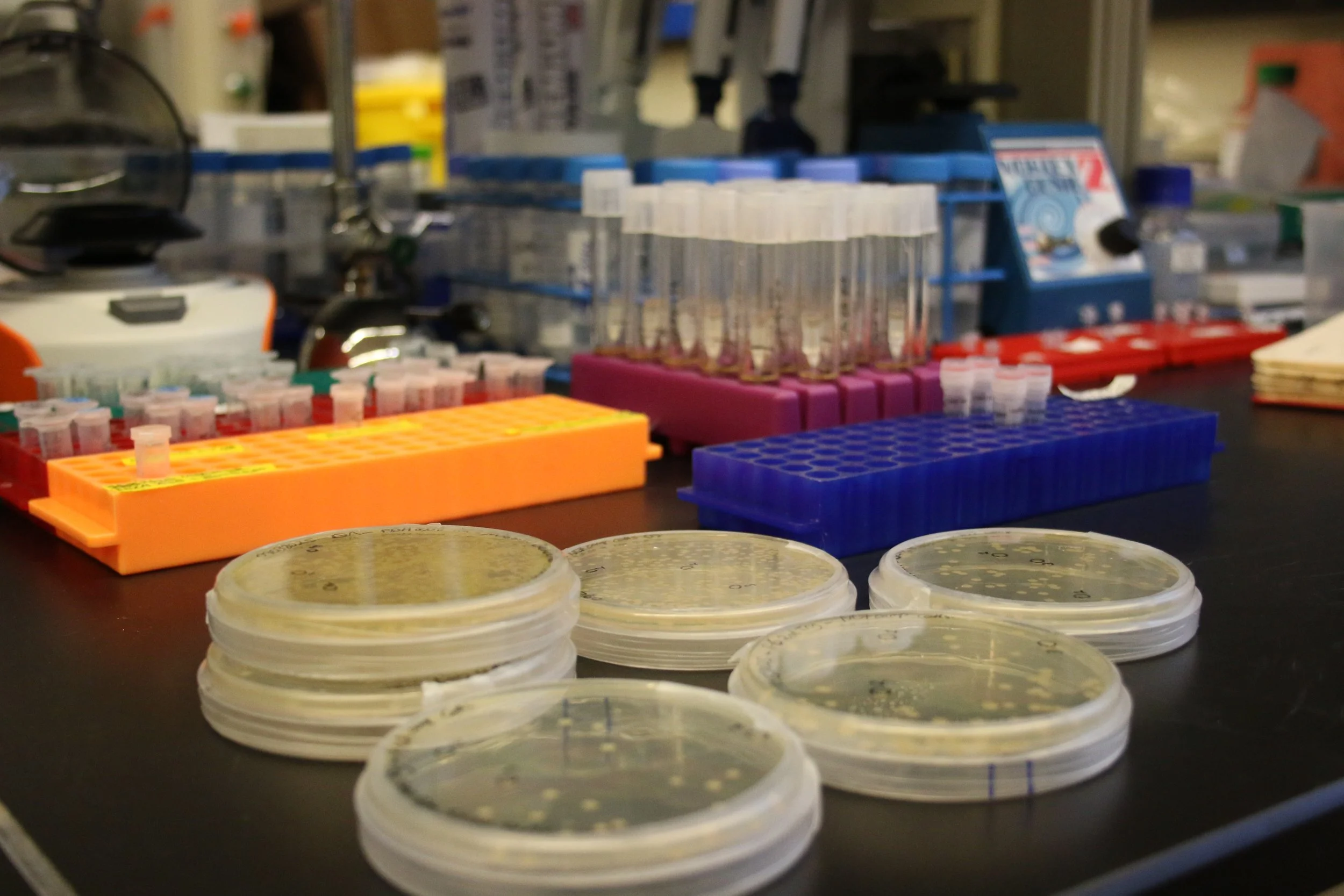
Photos by EllaRose Sherman (eks92@cornell.edu)
Perhaps surprisingly, this likely evolved individually. The two most commonly studied exoelectrogens (Geobacter sulfurreducens and Shewanella oneidensis) are genetically distant and have distinct methods of electron transfer. G. sulfurreducens relies heavily on microbial nanowires, which are modified pili with cytochromes that allow for electron transfer, while S. oneidensis produces extensions of its bacterial membrane [2]. However, for what reason did these bacteria develop such unique metabolisms? The answer is in their environment: when no oxygen is available, some kind of electronegative electron acceptor is needed, and given that metal oxides are readily available in the earth’s crust, the solution becomes clear [3]. If given enough time, bacteria are adaptable to almost any environment on earth due to their high reproduction and mutation rates.
Once grown on an electrode, these bacteria may conduct an electrical current through biochemical reactions. Due to the versatile nature of bacterial metabolism, this means that any substance, given it had the proper reactants, could act as “fuel” for this reaction, leading to the eventual creation of “Microbial Fuel Cells” (MFCs). By running wastewater through MFCs, small amounts of electricity could be generated, helping offset the energetic cost of wastewater treatment plants [4]. Modifications of MFCs would eventually result in a new spectrum of technology: bioelectrochemical systems.

Photo by EllaRose Sherman (eks92@cornell.edu)
By running a similar process in reverse (a process called microbial electrolysis) it was discovered that other bacteria could produce H2, an environmentally clean and energy-efficient fuel source, if provided with a small electric current, through oxidation of waste products [5].
Microbial electrosynthesis would later arise through a similar process. By running electrons through a microbe, CO2 (as well as a variety of other molecules) could be reduced into useful products such as butanol or acetate [6,7].
Although these technologies sound promising, it is also important to consider the practicality of many of them. MFCs have existed for many decades, but they have limited commercial applications, mainly due to issues with the efficiency of energy production. Thus, most recent research has been centered around methods of enhancing voltage output, whether it be modification of the bacterial populations at electrodes or altering the material of the electrodes themselves [4]. Looking into the future, it’s possible that our biggest problems may be resolved by Earth’s smallest organisms.
David Kim-Shoemaker ‘29 is in the College of Agriculture and Life Sciences. He can be reached at djk323@cornell.edu.
Sources
[1] B. Conley, “Microbial Extracellular Electron Transfer is a Far-Out Metabolism,” ASM.org, Nov. 15, 2019. https://asm.org/articles/2019/november/microbial-extracellular electron-transfer-is-a-far
[2] E. Howley, D. Ki, R. Krajmalnik-Brown, and C. I. Torres, “Geobacter sulfurreducens’ Unique Metabolism Results in Cells with a High Iron and Lipid Content,” Microbiology Spectrum, vol. 10, no. 6, Oct. 2022, doi: 10.1128/spectrum.02593-22.
[3] N. Zhao et al., “Dissimilatory iron-reducing microorganisms: The phylogeny, physiology, applications and outlook,” Critical Reviews in Environmental Science and Technology, pp. 1–26, Jul. 2024, doi: 10.1080/10643389.2024.2382498.
[4] A. S. Vishwanathan, “Microbial fuel cells: a comprehensive review for beginners,” 3 Biotech, vol. 11, no. 5, May 2021, doi: 10.1007/s13205-021-02802-y.
[5] Y. Koul et al., “Microbial electrolysis: a promising approach for treatment and resource recovery from industrial wastewater,” Bioengineered, vol. 13, no. 4, pp. 8115–8134, Mar. 2022, doi: 10.1080/21655979.2022.2051842.
[6] K. Rabaey and R. A. Rozendal, “Microbial electrosynthesis — revisiting the electrical route for microbial production,” Nature Reviews Microbiology, vol. 8, no. 10, pp. 706– 716, Sep. 2010, doi: 10.1038/nrmicro2422.
[7] F. Harnisch, J. S. Deutzmann, S. T. Boto, and M. A. Rosenbaum, “Microbial electrosynthesis: opportunities for microbial pure cultures,” Trends in Biotechnology, vol. 42, no. 8, pp. 1035–1047, Mar. 2024, doi: 10.1016/j.tibtech.2024.02.004.